Palm Bay driveways on a compacted sand base, sloped to drain toward the swale
Typical route of a local driveway: block home on a slab, quarter-acre GDC lot, culvert crossing over the roadside swale, then a street that may be next in line for reconstruction. Our scope covers the whole route. The base is recompacted, the slab gets steel, the surface falls the way Public Works expects water to run, and the apron is built to the city culvert specification. You receive the figure on paper before a mixer is booked.
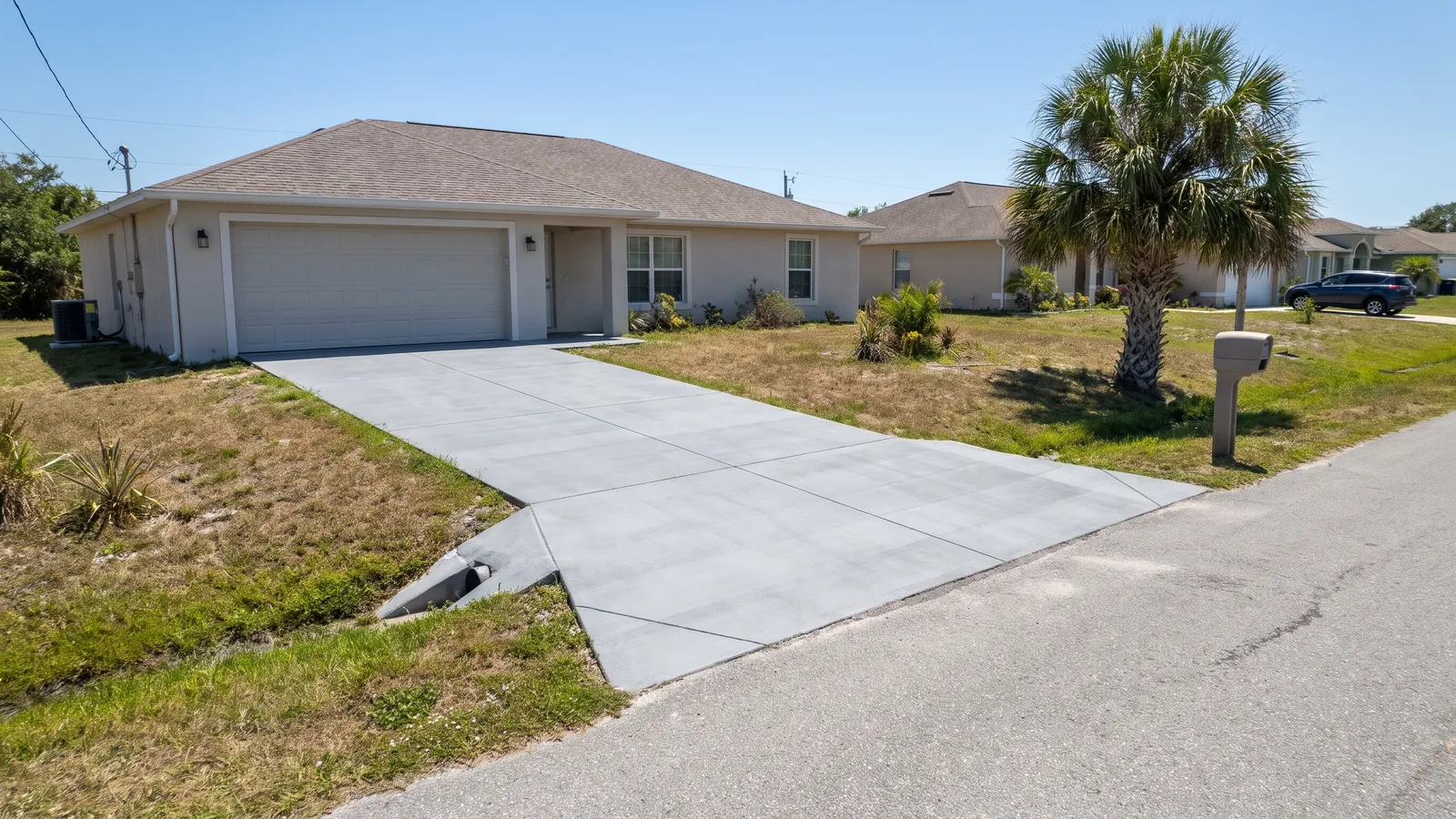
Nearly all Palm Bay driveways follow one layout. They start at the garage of a slab-on-grade block house, cross a quarter-acre lot that General Development Corporation platted as Port Malabar, pass over the roadside swale on a culvert pipe and meet the street. Condition depends mostly on when the house went up.
Northeast units such as Port Malabar, the Emerson and Eldron sections and Lockmar still carry original 1960s, '70s and '80s slabs, now on a third or fourth owner. Common defects there: settlement at the apron, a crack where a laurel-oak root lifted the slab, and spalling from forty years of morning sprinkler water. Bayside Lakes houses from the 2000s, and the boom-era homes going up today on Jupiter, San Filippo and the Compound, were frequently placed in a hurry over sand nobody compacted, with a downspout discharging at one corner. On hundreds of streets, GO Roads work has also moved the pavement up or down, and the old apron no longer lines up with it.
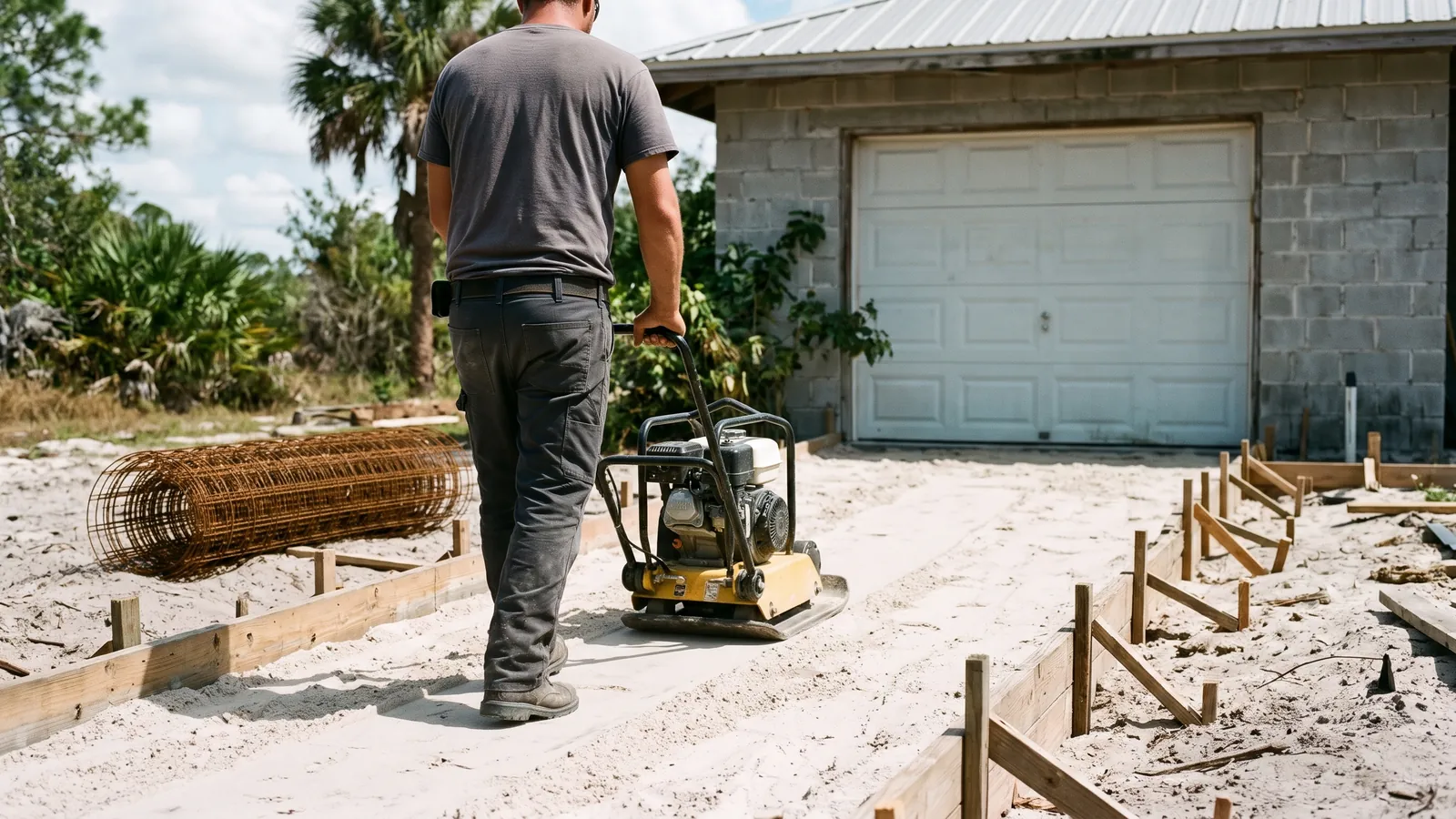
We treat the driveway as a full assembly, base to surface. Sequence: saw-cut and haul off the existing slab; remove organic muck and loose fill; rebuild the sand in compacted lifts to a level that stays above the wet-season water table; set forms for roughly ¼" of fall per foot away from the garage; place 3,000 psi fiber mix at 4" (5–6" at the apron and under boat or RV parking) over welded wire or rebar; cut control joints at no more than 10 ft spacing so cracking stays in the joints; broom the surface for wet-weather grip. New driveways, widenings, and any work that reaches the swale or the right-of-way go under a Public Works Driveway and Lot Drainage permit, with our crew calling for the pre-pour and the final inspection. Sealer goes on last.
What's included
Tear-out and new base
Existing slab removed and hauled away, muck and loose fill dug out, clean sand compacted lift by lift. This step decides whether the new slab stays put.
Fall toward the street
Roughly ¼" per foot sloping off the house and down to the road, so rain runs off rather than collecting at the garage door or the swale edge.
Fiber, steel, 4–6" depth
Fiber blended into the mix; welded wire or rebar in the slab. 4" across the lot, 5–6" at the apron and wherever boat or RV wheels sit.
Joint layout
Sawn or tooled control joints at 10 ft maximum spacing, with an expansion joint where the slab meets the garage floor or a city sidewalk.
Apron built to spec
Pipe, mitered ends and apron to the city specification, with Public Works permit and inspection, so the swale keeps moving water and the apron holds its grade.
Closeout
Permit filed where required, forms stripped, sand and debris swept off the road, penetrating sealer applied once the slab has cured.
Driveway pricing in Palm Bay, FL (2026)
| Job | Typical price | Notes |
|---|---|---|
| New two-car slab, 4" with broom texture (500–650 sq ft) | $4,800 – $8,200 | On the lot, base compacted |
| Two-car replacement: remove, haul, repour | $6,200 – $10,500 | Removal $2.25 – $4.25 / sq ft |
| Widening or boat-side addition (150–300 sq ft) | $1,700 – $3,700 | Frequent in NE and SW units |
| Swale crossing: culvert, mitered ends, apron | $2,400 – $5,200 | Public Works permit |
| Third bay or RV pad, 5–6" with rebar | $3,000 – $6,200 | Heavier section and steel |
| Stamped or colored, about 600 sq ft | $9,500 – $15,000 | Covered on the stamped page |
| Extra length on Compound or acreage lots, per 100 sq ft | $800 – $1,350 | Pump or dirt-road access possible |
Budget figures for Brevard County in 2026. The written quote breaks out demolition and haul-off, base, thickness and steel, finish, joints, sealer and permit separately, and the price holds for 30 days.
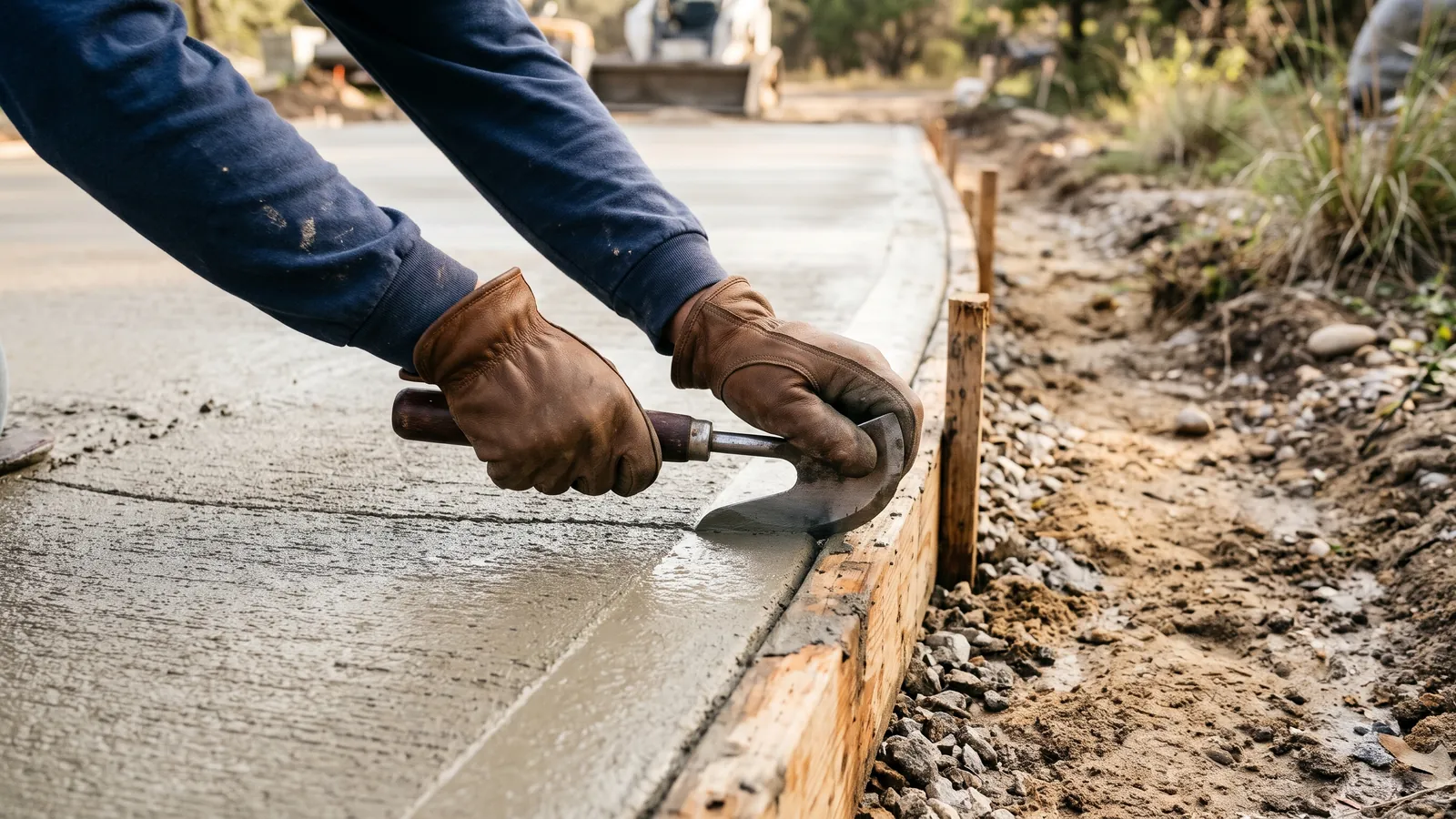
What the work looks like
Questions we get about concrete driveways
What is the timeline for replacing a driveway?
For a standard two-car driveway, three to five working days. Day one: saw-cut, haul off and rebuild the base. Day two: forms, steel and, when a permit applies, the Public Works pre-pour inspection. Day three: placement at first light. After that, foot traffic at 24–48 hours, vehicles at seven days, a boat at fourteen.
Does a driveway replacement in Palm Bay need a permit?
The apron and the culvert at the swale do. Palm Bay Code § 176.020 calls for a permit to build, remove, alter or repair any curb, culvert, sidewalk or driveway within a city road or easement. Public Works issues the Driveway and Lot Drainage permit on the iMS portal, supplies the pipe and grade specification, and inspects before placement and again at completion. The section on your own lot is usually not a building-permit item. Even so, we check with Public Works at (321) 952-3437 ahead of each job instead of assuming, and where a permit is needed we file it and bill it as a line item.
GO Roads repaved my street and the driveway no longer meets it. What is the fix?
This happens often. Reclaiming or rebuilding a street changes the road grade and the swale profile, so an apron that matched the old pavement may now sit as a lip or a drop against the new surface. The usual fix is a new apron at the new grade, plus a new culvert if the swale was reshaped. Because it sits in the right-of-way, it needs the Public Works permit. Our GO Roads guide covers the details.
Can new concrete go over the existing driveway?
Not with a lasting result. A topping placed on a cracked slab that is still moving will crack along the same lines within a year or two, and a 2" layer ends up higher than the garage floor and the sidewalk. The durable fix is removal, base repair and a new slab. If the driveway is sound underneath and only worn on the surface, a resurfacing overlay is a legitimate option, and we will say so.
Can a driveway be widened for a second car or a boat?
Yes, and on quarter-acre GDC lots it is among our most frequent requests, since the original single-width slab leaves the second vehicle on the lawn. The addition is doweled into the existing slab, the finish is matched, and the new edge stays within the setback. If the wider apron alters the swale crossing, that portion goes through a Public Works permit.
How do HOAs in Bayside Lakes or newer SW subdivisions handle driveways?
Most associations approve footprint, finish and color in advance, and some cap driveway width or require a specific apron detail. For the architectural review we supply a drawing and a written specification, and we have prepared enough of these submittals to know what the committee will ask.